While researching my Plaidy article, I came across a December 7, 1947, review in The New York Times of Beyond the Blue Mountains, Plaidy's first novel written under the Plaidy name. (Edit: Make that the second Plaidy novel. Thanks, Sarah!)
The reviewer is rather unimpressed: "This novel sings of illegitmate ladies and philandering men, and a long-winded, blowsy song it is. . . . This novel of generations is here coupled with a sampling of Amber-class heroines to produce a fiction so foolish and formula that its sponsors have seen fit in one place to label the creation 'A Romantic Novel.' It should offer limited appeal exclusively to readers of whatever that is."
Whew! And you thought historical fiction took some licks nowadays!
After three more paragraphs, in which the reviewer (identified as "B.V.W.") proceeds to give away most of the plot, he or she (odds are that it's a he) concludes, "It is pleasant to note, from the author's picture on the dust jacket, that she bears a winsome and charming resemblance to the British musical-comedy actress Jessie Matthews. Perhaps Miss Plaidy has missed her calling."
Well, no. Rather, millions of Plaidy sales later, it appears that B.V.W. sure missed the boat.
Showing posts with label jean plaidy. Show all posts
Showing posts with label jean plaidy. Show all posts
Tuesday, July 31, 2007


Monday, May 14, 2007
What's In a Title?
Looking at the back matter to The Queen's Secret, I've noticed that some of the upcoming Plaidy reissues are getting new titles:
Myself My Enemy, about Henrietta Maria, is going to be entitled Loyal in Love.
The Pleasures of Love, about Catherine of Braganza, is becoming The Merry Monarch's Wife.
William's Wife, about Mary, wife of William the Orange, is becoming The Queen's Devotion.
What do you think of these new titles? I think Myself My Enemy was somewhat better suited than the new title for the Henrietta Maria book, given the mood of the book, which is that of someone looking back on her mistakes and regretting some of her actions. Still, Henrietta Maria was certainly loyal. I did think that The Pleasures of Love was somewhat misleading for the Catherine of Braganza book, since poor Catherine is one of the few people in the novel who isn't enjoying the pleasures of love all that much. (And there is the difficulty of walking into a bookstore and demanding The Pleasures of Love; unless one hastens to mention Jean Plaidy, goodness knows what the clerk might pull up on the computer.)
William's Wife is definitely a dud of a title, but I'm not sure The Queen's Devotion is much of an improvement. It has a certain yawn-inducing quality to it. Given that one of Sarah Churchill's nicknames for William was "Caliban," I would have called it Caliban's Wife. But alas, no one ever asks me about these things.
Friday, April 6, 2007
Plaidy Comes to the New World--Another Link
Here's a link to a review by Gray, of Romance Reviewed, of Jean Plaidy's novel about John Smith and Pocahontas, The King's Adventurer--an interesting change from the novels about English royalty we usually associate with Plaidy. Another one to search out (per Gray, it may also be known as This Was a Man).
Victoria Victorious, and A Couple of Links
I've been reading Victoria Victorious, so look for a review soon. It's fairly interesting, so far. Though I've read a lot of Victorian novels, I don't know that much about Victoria herself, other than the very basics. It was interesting to see her portrayed, in the early part of her reign at least, as a bit of a brat, and Albert as a prig.
While I solider on with Victoria (long reign, long novel), here's a couple of Plaidy links for your perusal. Gata has a nice appreciation of Plaidy here. And here's a review by Kirsten of In the Shadow of the Crown.
While I solider on with Victoria (long reign, long novel), here's a couple of Plaidy links for your perusal. Gata has a nice appreciation of Plaidy here. And here's a review by Kirsten of In the Shadow of the Crown.
Friday, March 23, 2007
Plaidy Goes to the Dogs
As you can see, the UK reissue of The Revolt of the Eaglets has quite a clever variation on the ever-popular headless woman cover:

Maybe this will start a trend--I see possibilities for all sorts of combinations here. Anne Boleyn with Purkoy, perhaps.
Speaking of covers, there's a nice gallery of them here at Fantastic Fiction. My favorite is the one from Red Rose of Anjou. It's probably safe to say that the hunky guy on the cover isn't Henry VI.
Saturday, February 10, 2007
Queen in Waiting
I finished Queen in Waiting today. As I mentioned before, this historical novel, published originally in 1967, is the story of Caroline of Ansbach, wife to the future George II, before she became queen.
(By the way, this book, like its predecessor, has a very tasteful cover--some well-dressed men and women standing in front of a grand house with a Grecian sculpture in the foreground. I'm really missing the tacky clinch covers that grace some of my Plantagenet Plaidys.)
This book starts out rather gloomily, with Caroline's spiritless mother, Eleanor, making a disastrous second marriage that nearly results in her being poisoned. Fortunately, smallpox saves Eleanor by widowing her a second time, and with Eleanor's decline and death soon following, the story switches to the much more interesting figure of Caroline herself. We follow Caroline into her marriage with George Augustus, whose father is destined to become King George I of England. In what would apparently become a Hanoverian family tradition, George I and George Augustus hate each other heartily, and their jockeying for power once the family moves from Hanover to England forms most of the plot of the novel.
Caroline is an intelligent, shrewd opportunist who is quick to take advantage of George I's unattractive personality by ingratiating herself with the people. Though George I succeeds in getting control of some of Caroline's children, Caroline is no victim like her mother; the fight never goes out of her. I also liked George Augustus's mother-in-law, Sophia, who is pleased when George Augustus takes up with an English mistress: "It should improve his English," she tells the furious Caroline. Sophia is one of several cheerfully cynical characters here.
There are some repetitive moments; we're reminded way too often that George I has locked up his wife because of her love affair.
Amusingly, once the Hanoverians move to England, Plaidy reminds us of their heavy German accents by having the Prince and Princess of Wales speak sentences such as these: "Ve vill think of something, my tearest." This usually works well enough, but it tends to undermine Plaidy's more dramatic moments.
All in all, though, this novel left me looking forward to more dysfunctional family fun with its sequel, Caroline, the Queen.
Friday, January 26, 2007
William's Wife
William's Wife, told by Queen Mary, spans the time period from Mary's childhood to the day that she recognizes that she has contracted a fatal case of smallpox.
I found this novel readable and reasonably interesting, but I can't put it on the same level as The Queen's Favourites (Yay! I remembered the "u") or The Haunted Sisters. The book covers most of the events that are in the other two novels, particularly The Haunted Sisters, and Mary's perspective on these events simply isn't compelling enough to merit her first-person retelling of them. If Mary had a distinctive narrative voice or was more given to making sardonic comments about her contemporaries, it would be a different matter, but unfortunately the prose here is a bit plodding and repetitive. Mary also is a more competent and able person in The Haunted Sisters than she is here. All in all, her personality in this novel is rather muted.
William's character also suffers here. In The Haunted Sisters, he's reasonably complex, not all that likable but not a villain either, and he is genuinely fond of Mary, albeit poor at demonstrating it. (Indeed, the real-life William seems to have been deeply attached to Mary, at least during the latter part of the marriage, and was visibly grieved when she fell ill.) In this novel, though, William's simply an insensitive jerk whom one wishes Mary (or better yet, Sarah Churchill) would give a swift kick.
All in all, a middling Plaidy.
Friday, January 19, 2007
The Queen's Favourites
(I keep having to remember to add that "u." Though this was an US edition I read, it must have been before publishers went wild with Americanizing British spellings.)
I stayed up last night to finish this book, originally published in 1966, and like its predecessors, I enjoyed it thoroughly. As the title proclaims, it's about Queen Anne's rival favorites, Sarah Churchill and Abigail Hill. The novel opens with the first meeting between Sarah Churchill and her impoverished relations, the Hills, and ends with the death of the elderly Sarah decades later.
This book proceeds at a leisurely pace, allowing Plaidy to examine the characters of Sarah and Abigail in depth. Arrogant and insensitive, Sarah is largely unsympathetic, but Plaidy avoids turning her into a caricature, chiefly because of the genuine love depicted between her and her much more likable husband, John ("Marl" as she calls him). The scene where Sarah finds that her late husband has stored up her tresses of hair, famously cut off by Sarah during a fit of temper, is touching, as are the other scenes where Sarah must bear the losses that come to her just as they come to lesser mortals.
Abigail, deceptively meek and mild, is also well portrayed, especially in the latter part of the book, where she must deal with unfulfilled yearnings despite having achieved her ambition.
Queen Anne herself is an interesting character, her placid, almost insipid manner hiding a stubborn nature and a willingness to be pushed only so far.
With a few exceptions, the men in this novel are relegated to the background, though John Churchill and Robert Harley, Abigail's dissolute ally turned enemy, play prominent roles. The focus, though, is definitely on the "petticoat politics" of Queen Anne's reign.
Ophelia Field in her 2002 biography of Sarah Churchill, The Favourite, speaks dismissively of this novel, writing, "Facts taken from schoolbook history lie like uncrushed pills in the jam of this romantic fiction, heavy with forebodings of disaster and clunking dialogue." (Field also describes the television drama "The First Churchills" as "drily educational and theatrical.") Field's biography (as far as I can tell from skimming it) is readable and intelligent, but I can't agree with her assessment of Plaidy's novel. The dialogue here doesn't sparkle, but I wouldn't call it "clunking" either; in fact, Plaidy catches Anne's maddeningly repetitive speech, Sarah's fulminations, and Abigail's subtle way of suggesting ideas to Anne quite well. And romantic? I'd hardly call the characters here, who suffer disillusionment and disappointment, and who often make mistakes and suffer for them, romantic.
Besides, if this was a romance, it'd have Sarah Churchill with a bare-chested John Churchill on the cover, and it doesn't. So there.
Saturday, January 13, 2007
Surfin' With Plaidy
Ouch! It's been too long since I last posted. I have been reading a Plaidy novel, The Queen's Favourites, though, so I'll soon be reporting on that. It's the story of the reign of Queen Anne and of her rival favorites, Sarah Churchill and Abigail Hill. So far it's quite good.
In the meantime, here's a link to Tanzanite's review of The Vow on the Heron, which is about Edward III and his family. I agree with her that it's nice to read about Edward III's family, particularly the female members, who often get overlooked by historical novelists.
Are you on MySpace? If so, check out Julie's newly formed Jean Plaidy Addicts group.
Doing a little more surfing tonight, I noticed this link entitled, Who Writes Like Jean Plaidy?, courtesy of the Clackmannanshire Council. (Where, I said to myself, is Clackmannashire?) Seeing Dorothy Dunnett on the list reminded me that I really need to be a good girl and check her out one of these days, but it's hard with all the Plaidys on my shelf calling out my name.
Here's a quiz by gemini chick entitled, So You Think You Know Jean Plaidy? I didn't do very well at all, I'm mortified to report. But at least I know now that I'm unlikely to run out of material for this blog any time soon!
Editor Rachel Kahan has some fine things to say about Jean Plaidy in this article on the Irene Goodman Literary Agency site.
Borders has posted some discussion questions about The Rose Without a Thorn, one of Plaidy's novels about Katherine Howard, here.
And finally, here's a very attractive website by Lynne M. Kennedy for the Sachem Public Library entitled The England of Jean Plaidy. This not only lists Plaidy's novels but describes them briefly--a great help. Be sure to check out the link for additional historical fiction as well.
Friday, January 5, 2007
Another Link: The Rose Without a Thorn
Here's a link to Clare's review of a Plaidy book about Katherine Howard, The Rose Without a Thorn.
I've read this one, but it's been quite a while. One day I'll have to pick it up again.
I've read this one, but it's been quite a while. One day I'll have to pick it up again.
Thursday, January 4, 2007
The Haunted Sisters
Like the new blog colors? They struck me as being more Plaidy-ish than the orange that was there before.
Anyway, I finished reading The Haunted Sisters yesterday, and enjoyed it thoroughly. It's the story of Mary and Anne, daughters of James II, and covers the latter part of Charles II's reign to the death of King William at the hands of the Little Gentleman in Black Velvet--the mole whose hole caused the king's horse to throw its rider. In between these events, intrigue and treachery abound.
The characters are vividly drawn. Neither Mary nor Anne is particularly sympathetic at first, as both are living in the shadows of other people--Mary in that of her husband William, Anne in that of the ubiquitous Sarah Churchill. Mary grows from the passive tool of her husband into a ruler able to make wise decisions, and even Anne is beginning to develop a backbone by the end of the novel. Indeed, part of the fun of the novel is seeing Sarah get her comeuppance on occasion. Sarah herself, though thoroughly disagreeable, is vastly entertaining; horrible to live with, no doubt, but fun to watch. Anne's sickly son, the Duke of Gloucester, is charming without being cloying.
I'm looking forward to the sequel to this, The Queen's Favorites, and will be on the lookout for The Three Crowns (about William) and William's Wife (about Mary). In the meantime, Maureen Waller's 2002 nonfiction book, Ungrateful Daughters: The Stuart Princesses Who Stole Their Father's Crown, is a fascinating and readily available account of the events covered in these novels.
Friday, December 22, 2006
The Pleasures of Love (No, It's Not That Kind of Blog)
I finished reading Plaidy's The Pleasures of Love, about Catherine of Braganza, wife to Charles II, yesterday. I'd say it was one of the better Plaidys I've read.
Catherine, of course, was obligated to tolerate Charles II's many mistresses and, worse yet, watch as they bore her husband child after child while she suffered miscarriages. Nonetheless, the couple were fond of each other and grew closer in adversity. As a Catholic in a Protestant country, Catherine was a perennial outsider and an easy target for the disaffected, especially when it became apparent that she was unlikely to produce an heir to the throne.
It's a tribute to Plaidy's skill that both Charles and Catherine come off as sympathetic characters, as it would be all too easy to fall into the trap of making Charles a lecherous jerk or Catherine a colorless dishcloth. Instead, Charles's charm is readily apparent here, and though Catherine (the narrator) lacks his wit and magnetic personality, and is more an observer of events than a participant in them, she still is an attractive character, making the best of her circumstances and seldom yielding to self-pity. The relationship between the royal couple, complicated as it is by the other women in Charles's life, is a visibly affectionate one.
It's interesting to compare this book with Doris Leslie's The Sceptre and the Rose, also about Catherine. Leslie's book covers most of the same events that Plaidy does but uses a third-person omniscient narrator; she's also quite sympathetic to both Catherine and Charles. She has a jauntier writing style than Plaidy and spends more time in sketching character (her Barbara Villiers is a memorably nasty specimen), but Plaidy's narrative is a little easier to follow, especially for someone (like me) not all that familiar with the history of the period. Both, though, are well worth reading.
Neither book spends much time on the period after Charles II's death, although Plaidy does devote a few pages to Catherine's precarious position in the reign of William and Mary and to her return to Portugal, where she served as her brother's regent for a while. It's a pity that there's not more on the latter episode, for it seems to have been a time where Catherine was able to demonstrate the strength and intelligence that were overshadowed during her stay in England.
An enjoyable book about a queen exhibiting grace under pressure.
Thursday, November 30, 2006
Myself My Enemy
I got on an English Civil War kick a little while ago, and when I started to look around for some novels to read, one of the first I came across was Myself My Enemy, Jean Plaidy's 1983 novel about Henrietta Maria, wife to Charles I.
Myself My Enemy is written in the first person, and traces Henrietta Maria's growth from a headstrong young girl to a more reflective older woman, one with many regrets.
This isn't the best novel about the English Civil War I've ever read. Plaidy's prose isn't particularly memorable, and she always tends to tell more than to show. Nonetheless, Plaidy has a gift for getting inside her characters' heads and making the reader care for them, and I thought she did that well with Henrietta. Fiercely loyal to her husband, deeply committed to her Catholic faith, suffering myriad tragedies, and just as often doing the wrong thing as the right one, Henrietta is an interesting heroine, and Plaidy succeeds in making her an appealing one despite her manifest flaws, of which Henrietta is all too aware despite her best efforts to rationalize her actions to herself. Her wavering between self-knowledge and self-justification is depicted particularly well in the scene where Henrietta mourns her son Henry, whom she had alienated before his untimely death by attempting to convert to Catholicism.
Plaidy depicts Charles I sympathetically, without idealizing him, and the relationship between him and Henrietta is moving. Charles II, blithely ignoring his mother's advice, and not without good reason, is also well drawn.
Judging from the reading I've done since about Henrietta Maria, Plaidy seems to have researched Henrietta's life thoroughly and stuck to historical fact, a refreshing contrast to some more recent novels I've read about other historical figures.
All in all, an interesting introduction to a beleaguered queen, and one that got me scouring the library to learn more about Henrietta.
Tuesday, November 28, 2006
Plaidy on Literature Map
I pulled up something called Literature Map today, which answered the question, What else do readers of Jean Plaidy read? Supposedly, the closer the name appears on the map to Plaidy's, the more likely a reader who likes Plaidy is to like the other author's books. I say "supposedly," because when I tried it, I got a different result each time--on one occasion, a writer named Elizabeth Ogilvie was smack next to Plaidy, while on another, Ogilvie's name was at a much greater distance.
Still, it's fun to play with (watching the names jounce around is sort of like watching fish swim) and running the query (it works with other authors too, of course) pulled up some names I didn't recognize and will have to look up one of these days.
Still, it's fun to play with (watching the names jounce around is sort of like watching fish swim) and running the query (it works with other authors too, of course) pulled up some names I didn't recognize and will have to look up one of these days.
Friday, November 24, 2006
A Fun Cover to Get Us Started
If you've seen my other blog, you know that I frequently review historical fiction on it. Because I prefer to read about English history, I quite often read Jean Plaidy novels. Even though many are out of print, they're easy to find and usually quite cheap.
I've reviewed some of the Plaidy novels on my other blog, but face it, Plaidy was so prolific, if I tried to review them all there, it'd soon turn into a Jean Plaidy blog, which would be a bit of a bore for readers who aren't all that interested in her books. Hence the present blog, where I can post as much as I please about Plaidy without guilt.
Jean Plaidy, of course, was the pseudonym for the author Eleanor Hibbert, who also wrote novels as Victoria Holt and Philippa Carr (among others). My focus here will be on the Jean Plaidy books, but I may venture into the Holts as well, depending on what grabs my interest.
So now to get started.
As you may know, a lot of Jean Plaidy's novels are being reissued, with classy new covers. Some of them are quite lovely, but I have a soft spot for some of the older ones, like this one from The Vow on the Heron, a 1980 novel about Edward III.
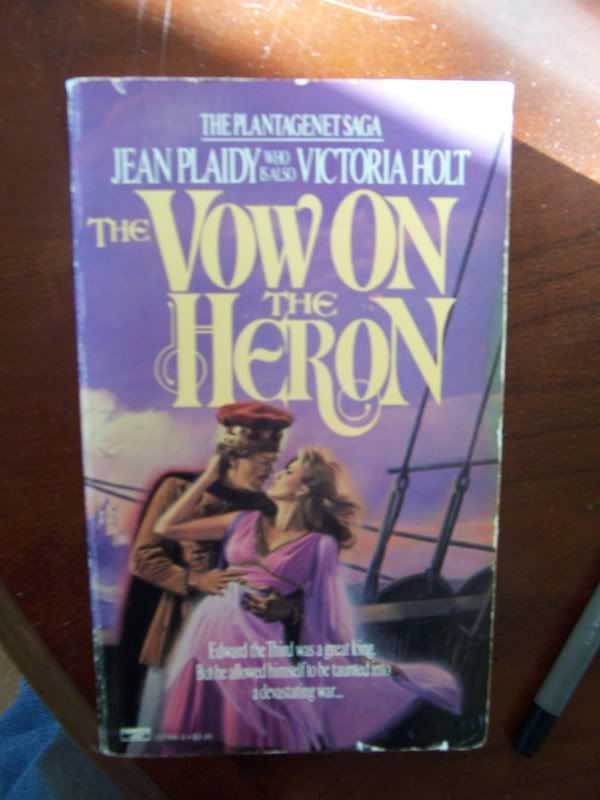
This cover is from a 1984 paperback edition, and one of the things that has baffled my existence is wondering who the Farrah Fawcett-like blonde on the cover is. Queen Philippa would seem to be the most likely candidate, but the woman isn't crowned, and in any case, Queen Philippa by most accounts wasn't the hot number that this blonde is. Alice Perrers? Maybe, but if so, Edward III's way too young, as he took up with Alice late in life. Joan of Kent? The Countess of Salisbury? Possibly, but what on earth are they doing on a ship, anyway?
The mind boggles.
If you have suggestions, I'd love to hear from you.
I've reviewed some of the Plaidy novels on my other blog, but face it, Plaidy was so prolific, if I tried to review them all there, it'd soon turn into a Jean Plaidy blog, which would be a bit of a bore for readers who aren't all that interested in her books. Hence the present blog, where I can post as much as I please about Plaidy without guilt.
Jean Plaidy, of course, was the pseudonym for the author Eleanor Hibbert, who also wrote novels as Victoria Holt and Philippa Carr (among others). My focus here will be on the Jean Plaidy books, but I may venture into the Holts as well, depending on what grabs my interest.
So now to get started.
As you may know, a lot of Jean Plaidy's novels are being reissued, with classy new covers. Some of them are quite lovely, but I have a soft spot for some of the older ones, like this one from The Vow on the Heron, a 1980 novel about Edward III.
This cover is from a 1984 paperback edition, and one of the things that has baffled my existence is wondering who the Farrah Fawcett-like blonde on the cover is. Queen Philippa would seem to be the most likely candidate, but the woman isn't crowned, and in any case, Queen Philippa by most accounts wasn't the hot number that this blonde is. Alice Perrers? Maybe, but if so, Edward III's way too young, as he took up with Alice late in life. Joan of Kent? The Countess of Salisbury? Possibly, but what on earth are they doing on a ship, anyway?
The mind boggles.
If you have suggestions, I'd love to hear from you.
Subscribe to:
Posts (Atom)